

What is a 4 Post Car Lift?
In the context of the booming automobile industry today, the automobile repair and maintenance industry is also thriving. The 4 post car lift is one of the most important pieces of specialized mechanical lifting equipment.
A 4 post car lift is a device that relies on four columns to achieve the lifting function. It is mainly designed for the repair and maintenance of large-tonnage cars or trucks. Due to the large weight and complex structure of these vehicles, ordinary lifting equipment often cannot meet their maintenance needs. The 4 post car lift has become a powerful assistant for the maintenance of such vehicles, thanks to its strong carrying capacity and stable structure.
Applications of 4 Post Car Lifts
4 post car lifts are widely used in the field of automobile maintenance, particularly in two key areas: four-wheel alignment and vehicle chassis inspection. For large-tonnage vehicles, the greater pressure of their body weight on the chassis and suspension system increases the accuracy requirements for four-wheel alignment. The 4 post car lift can smoothly lift the vehicle to a suitable height, providing technicians with the necessary space for precise operations, thereby ensuring the accuracy of four-wheel alignment.
In terms of vehicle chassis inspection, the chassis structure of large-tonnage vehicles is often more complex, and due to long-term heavy loads, chassis components are more prone to wear and deformation. The 4 post car lift allows maintenance personnel to safely lift the vehicle, enabling comprehensive and careful checks of various chassis components, such as the drive shaft, suspension system, and brake system. This is crucial for identifying potential problems and ensuring the vehicle’s driving safety.
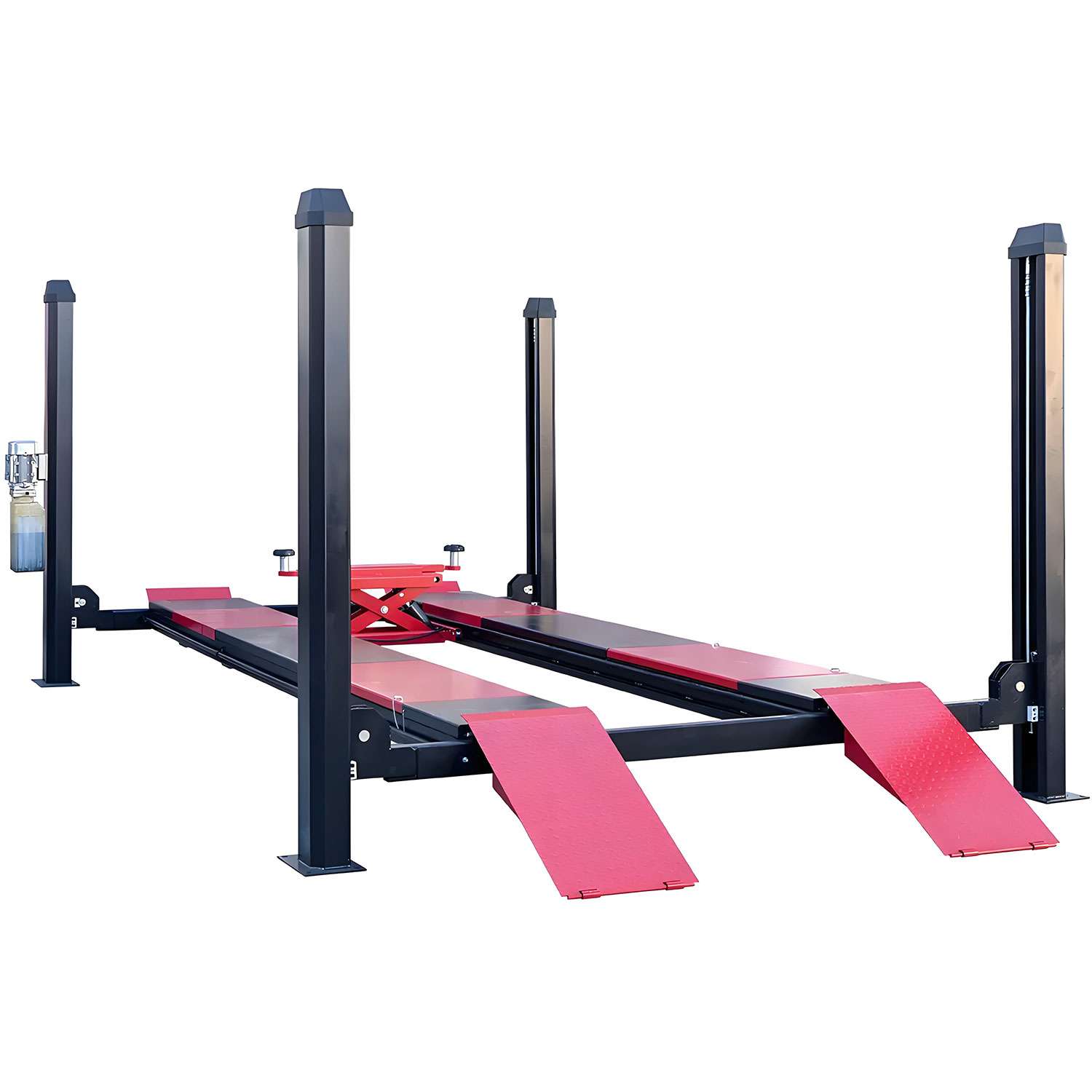
Structure of the 4 Post Car Lift
The 4 post car lift can be divided into two types based on its structure: upper cylinder type and lower cylinder type.
- Upper Cylinder Type: The cylinder is placed on top of the column (with a crossbeam) and relies on four chains to lift the vehicle. While this structure is simple, it increases the deadweight and often requires manual or pneumatic secondary lifting, which can be inconvenient and unsafe.
- Lower Cylinder Type: The cylinder is located under the flat plate, using four thick steel cables to lift the vehicle. This structure is more compact and has a lower deadweight. The secondary lift is generally electric and hydraulic, making it more convenient and safer to operate.
Working Principle of 4 Post Car Lifts
- Hydraulic System: The main component of the 4 post car lift is the hydraulic system. When the start motor button is pressed, the motor drives the oil pump, which moves pressure oil into the cylinder to lift the piston rod. The hydraulic pump supplies oil to the hydraulic cylinder, which tightens the steel wire ropes to lift the platform.
- Descent Process: To lower the lift, the mechanical safety locks are disengaged, and the manual valve is pressed to release the oil, allowing the platform to descend safely.
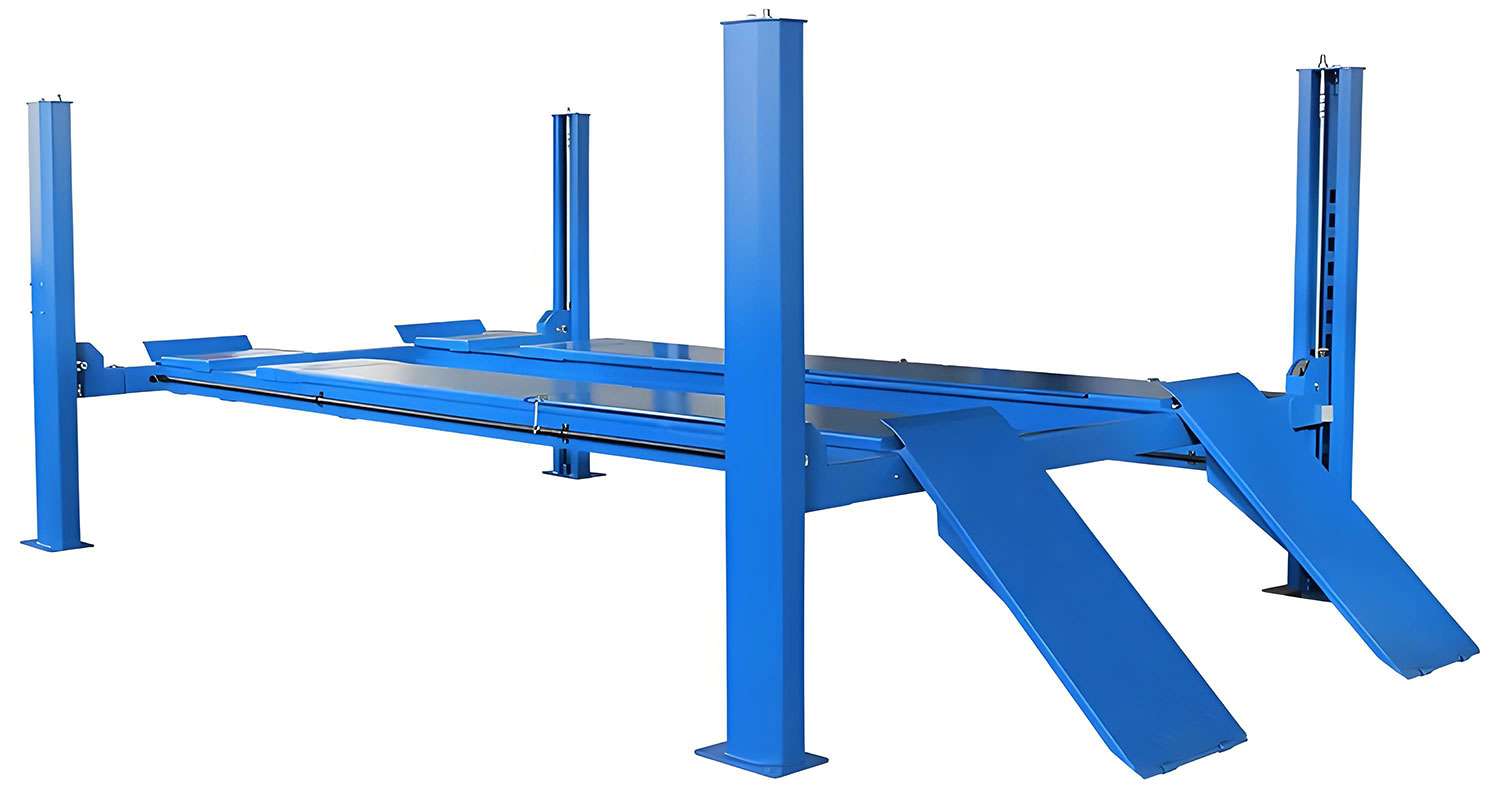
Advantages of 4 Post Car Lifts
- Safety Performance: Equipped with automatic power-off protection and reliable safety devices to ensure safe operation.
- Powerful Lifting Capacity: High-horsepower motors and lifting capacities of up to 3.5 tons to handle various vehicle weights.
- Design Features: Low noise and vibration, expanded lifting platform width, and spacious working space for maintenance personnel.
- Easy Maintenance: Designed to prevent oil leakage and equipped with electric hydraulic secondary lift functions for improved efficiency.
- Flexible Operation: Multiple reversing modes available to accommodate different user preferences.
Application Scenarios of 4 Post Car Lifts
- Auto Repair Workshops: Commonly used for overhauling and maintenance of cars, SUVs, and trucks.
- Vehicle Inspection Stations: Utilized for safety inspections and emission tests.
- Auto 4S Shops: Used for inspection and maintenance of new cars.
- Garages and Private Workshops: Suitable for daily maintenance and minor repairs in home garages.
Considerations When Choosing a 4 Post Car Lift
- Load Weight: Ensure the wire rope diameter matches the actual load weight for safe use.
- Lifting Height: Choose a lift that meets the required height for comfortable and safe operation.
- Use Environment: Consider environmental factors like humidity and temperature that may affect performance and longevity.
- Workshop Structure Layout: Understand the workshop layout and expected frequency of use to select the appropriate model.
- Safety and Maintenance: Look for safety features and ease of maintenance to reduce long-term operating costs.




 English